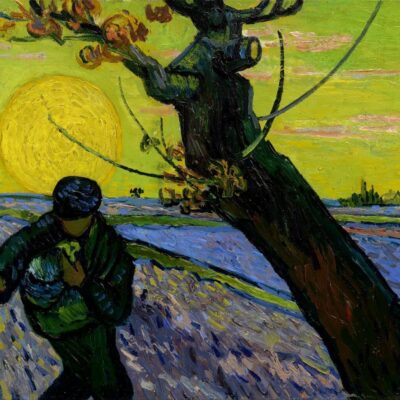
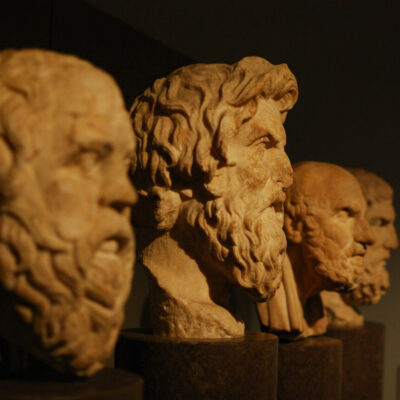
(Feature image: AI generated)
Our latest article in Luxury Briefing Magazine argues that luxury brands' long-standing human craftsmanship narrative is culturally relevant again. Because AI is doing to creative work what industrialisation once did: making mass-produced content cheap and universal while making real craft rare. Great for luxury brands.
The full copy is below, and you can a selection of our favourites from our 'Brand Matters' series by following the links at the end of the article.

In 2015, Om Malik one of Silicon Valley's most respected tech journalists interviewed an Italian cashmere maker. Cucinelli. He talked about Rousseau. Forget the goats. Or Mongolia. This was not a conversation you expect. But then Cucinelli is an unusual businessman. He spoke about Rousseau being the first of the Romantic movement and what this meant. Imagine. How rare is it that any business - well anyone really - thinks philosophically.
Rarer still from a luxury brand that backs it up with real action and behaviour. Their website page on 'Humanistic Capitalism and Human Sustainability' is a joy to behold. But what makes Cucinelli interesting now is that the culture, the mood music, appears to be with him. And you don't need a weatherman to know which way the wind blows.
People are noticing that Handmade is a Radical Act. Anti-Screen. Made by human hands is about touch, judgment, care, texture - all hallmarks of quality.
Well, that's OK. Because luxury has always had handmade well sewn up, in its pocket, its mantra, its saving centuries-old grace. Its craft stories are all rooted in sourcing the best, the newest, the oldest, the rawest materials.
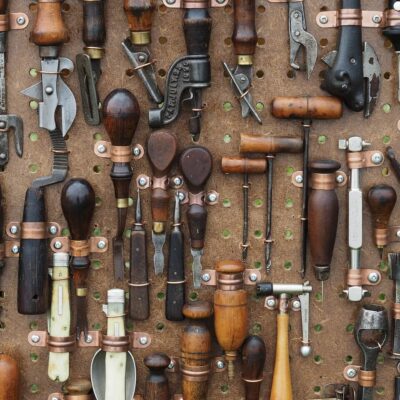
The artisans, artists all of course - in their studios, their ateliers, at their benches, in the vineyards, weaving, sketching, colouring, sewing, finishing, enamelling, smelling, touching, moulding, soldering. They do what the Romantic argument does: insists on the particular, the physical, the human.

Frictionmaxing
Which brings us to a new word. Hot on the heels of statusmaxxing, facemaxxing and sleepmaxxing comes frictionmaxxing which, as reported recently in London's Evening Standard, means reading a book. That's what it's called now. You know, you have to pick it up, feel its heft, turn the pages, you can't scroll it.
Leading cultural commentators like Ted Gioia pointed out last year that technocracy has grown so oppressive and manipulative it will cause a backlash. And that rebellion might resemble the Romantic movement of the 1800s.
(Reader alert: the next few paragraphs contain a small history lesson). In those times rational algorithmic models were dominating every sphere of life and people started attacking them. Companies grew more powerful, promising the usual productivity and prosperity. Blake called them "dark Satanic mills" and Luddites started burning down factories. Futile really. Like throwing away your smartphone. Or saying vinyl's back big time.
Science/tech produced amazing results, but people resented these new violent, intrusive forces. Progress brought a seismic shift to life. What was the creative, thoughtful response?
Feeling and emotion
Artists, poets and musicians celebrated human feeling and emotion, embracing them as more trustworthy, more flexible, more desirable than technology, profits, and cold calculation.
It produced greatness. Keats: "Beauty is truth, truth beauty", written in direct response to a world increasingly governed by utility. Wordsworth and Coleridge's Lyrical Ballads were the founding document of English Romanticism: ordinary people, ordinary speech, the natural world as spiritual teacher. Turner painted 'Rain, Steam and Speed' with a train emerging from a storm of light and weather.

Constable: "The sound of water escaping from mill dams, willows, old rotten planks, slimy posts and brickwork. I love such things." A manifesto in a sentence. The Pre-Raphaelites Rossetti and Millais rebelled against the Royal Academy's mechanical style, returning to a handmade 'truth to nature.' Chopin and Beethoven made their painful inner lives the subject of their music.
None of them were against tech or progress. They were against the idea that progress was the only thing that mattered - that efficiency, productivity and rational calculation were the only measures of being human. They felt that feeling, beauty, impermanence, truth, love, grief, the smell of a wet field, the sound of a stream were not simply decorations to life. They were the heart and soul of it.
Emotions that are exactly what great luxury brands say, allude or aspire to.
Luxury at its best
Luxury, at its best, has always made the Romantic argument: that the particular matters, that process matters, that time spent is value created, that the human hand leaves a trace no algorithm can reproduce.
Cucinelli knows it. That's what makes him unusual. And that's what makes this moment, when culture is exploring the same ground, so interesting for the brands paying attention.
Last December, Porsche released 'The Coded Love Letter': hand-crafted 2D animation, not a single AI-generated image. It went viral almost immediately. Months of human labour, as the message itself. A direct counterpoint to the fast, faceless content of mass-market brands.
Natural wine has gone from niche to premium sector. By emphasising hand-made production over industrial manufacturing it positions itself as an authentic, living product where perceived imperfections - cloudiness, varied flavour profiles - are presented as essential, unique characteristics.
Some watchmakers like Philippe Dufour or MB&F (Endline: ‘A creative adult is a child who survived’) are not doing the well-worn heritage story but making pieces where the hand-finishing is literally the point, the bevelling and polishing of parts no one will ever see.

Meanwhile Hermès, Loro Piana and Bottega Veneta just kept on keeping on. Minimal logos, minimal noise. Restraint as the loudest possible statement.
AI has done to creative work what the power loom did to weaving: made it fast, cheap, and available to everyone. And in doing so it has accidentally made human craftsmanship - that luxury does so well - into the new rarity.
Cucinelli saw it coming. He just got there via Rousseau rather than a streaming algorithm.
Moral of the story?
Luxury brands should keep playing the hits.
Anew's hitmakers
Its two founders deliver: insights from market research, strategic brand thinking, new brand names, luxury logo design, messaging, online and offline content, coffee table books and luxury brand websites. We help companies increase brand profitability through sharper insights, distinctive propositions, creative ideas and faultless execution.
To get in touch do drop us an email. We'd be delighted to meet for a coffee, either face-to-face or virtually to discuss your brief.
Read more from our Brand Matters series:
- The art of lasting for luxury brands here
- Forget stealth wealth for a minute. This is about the power of excess and how luxury is weaponised as power here.
- How luxury magnifies the spirit and can take us to a higher place here
- Whispers and shouts: the global language of Luxury here
- Does everyone buy into the mythmaking of luxury brands here
- There is still room for grace, awe and wonder here
- The luxury Brand Playbook here
- Behind the beauty of luxury here
- How privacy and escape from the coarse excesses of the world is becoming more desirable for luxury brand consumers here
- The enduring importance of craftsmanship here
- Why craftsmanship's vulnerability will win in the tech world here.
- Luxury is ageing gracefully here
- Why the pursuit of authenticity is paramount for luxury brands here
- Exploring the symbolism of colour for luxury brands here
- Why beauty, elegance, timeless high quality, durability and a little self-indulgence can be good for you here
- The importance of being reassured here